Art, artist and artist's assistants
- Amna Qamar

- Oct 4, 2020
- 3 min read
Updated: Oct 12, 2020
The meaning of art is subjective. Is it sufficient to just think of an idea? Is it enough to just perform the technical skillful work? Can a single person take ownership of a work produced by say thirty other people?
We often take 'help' and 'assistance' very lightly. But there are social and ethical values that should be taken into consideration when hiring assistance. My site-specific installation required labor to carry the heavy concrete bricks from outside my house to my room inside. Bricks require manual strength and careful handling because there is a greater chance of risk than compared to other materials. I conceived the idea but just to carry and place the bricks I was dependant on my servant to assist me. When you involve others in your work, there is a greater chance of deviation. My servant, for instance, might not able to comprehend my work or my perspective. Therefore, it became necessary for me to instruct him where to place each brick as per my design.
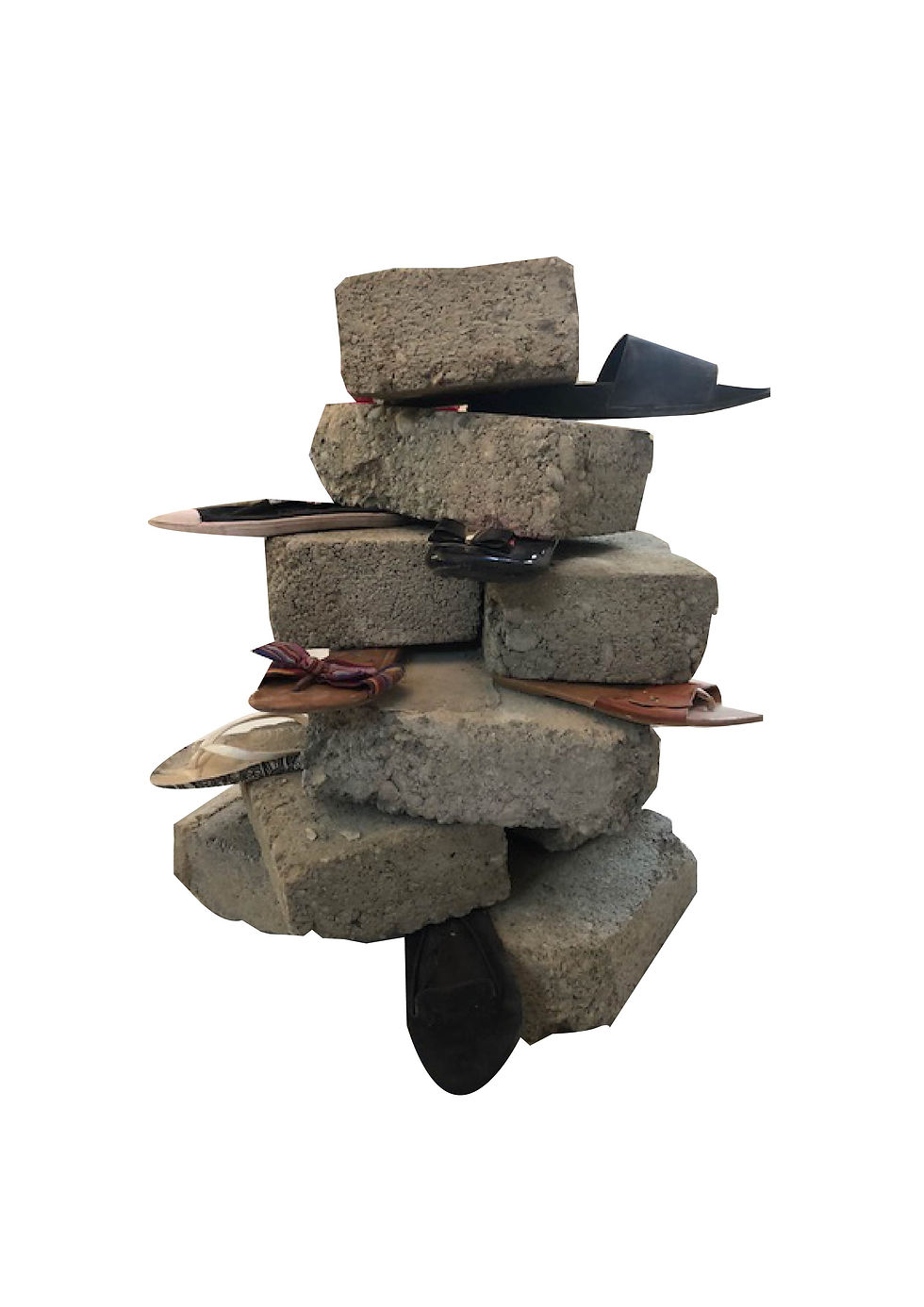


My installation led me to question the expansive use of workers, especially in large-scale installations. Why is it that an artist feels the need to hire assistants? Who does most of the art? Whose art is it?
As a practice, artists employing assistants to create work isn’t novel. Michelangelo, for instance, had assistants to help him paint backgrounds on the ceiling of the Sistine Chapel. He had borrowed the help of his friend Francesco Granacci to assist him and gave him the job to recruit further assistance in Florence. He did not leave it all to his assistants but painted along-side.In contemporary art, we see that the dependency on assistants has increased so much so that even the final display has no contribution by the artist himself. In promotional material and pamphlets, the works are usually attributed to a single artist ignoring everyone who was involved in the process.
David Hockney quoted a Chinese saying that to paint “you need the eye, the hand, and the heart. Two won’t do.” Furthermore, in an exhibition, he made it clear that all his paintings are made by himself. This was a direct comment on Damian Hirst's work who is blamed for producing and exhibiting work done entirely by his assistants. Hirst claimed that he employs assistants to produce the spot works, out of which Hirst created just five of an estimated 1,400 spot canvases in existence. Furthermore, Damian Hirst has his factory workshops where he employs more than 100 workers to realize his creative vision.

There are many opposing remarks by different artists on this topic. Andy Warhol and Jeff Koons have 'art factories' which normalize a hands-off approach to creating art. Koons himself admits to employing a staff of 150, saying, “If I had to be doing this myself, I wouldn’t even be able to finish one painting a year.” In the studio, assistants are expected to create work that solely follows Koons’ direction, they replicate his process and his techniques. On the other hand, Albert Oehlen insists on painting every brushstroke himself, ''it’s hard to find a person whom I could trust that much. Look, it’s not just that he or she could watch me paint in the studio, they’d be able to look inside my brain, to see me think! I don’t grant that to just anybody. ”


In certain cases, it becomes justified for the artist to hire assistants. For example, Lui Bolin puts himself in the art pieces and requires the help of others to camouflage him into the environment, in this case, the artist is actively participating and has not dissociated or left the work for his assistants.


To what extent is it justified to get your work done by someone else and call it yours?
The question of taking assistance can also be viewed in terms of what is the purpose of the artwork and on what scale is it being produced. The breakneck speed at which art is both digested and sold today has many artists relying on means outside of their own skill set to execute their work. It comes down to the individual preferences of the artist, the dealer, and the collectors. While the use of assistants is broadly accepted in contemporary art, some still prefer the romantic approach to art creation and only interact with or buy art made exclusively by the artist’s hand. Furthermore, it is important to maintain a healthy workforce where the laborers are satisfied with their job and work and have no issue in the artist wholly claiming the art done by them.



Comments