Art of Karachi's everyday life
- Amna Qamar

- Dec 7, 2020
- 7 min read
Artists, throughout time, have been trying to overcome the culture of being chosen by galleries/curators or having the need to rely on any institutional support to exhibit their work. Even at the times of state dictatorship and censorship, the galleries have little power to continue as there are dangers of artworks being banned. Art, as a norm in our Pakistani society, is not considered as professional as other fields such as engineering, science, etc. It's surprising then how it is the first thing that gets censored or removed because of its political concerns, implying that ''art has the power or relevance in the very society that marginalizes it''.[1] Karachi Pop Art Movement was started by Durriya Kazi, David Alesworth, Iftikhar Dadi, and Elizabeth Dadi in the 1990s as a reactionary art practice that overcame the anti-progressive 'Islamic' laws of Zia'ul Haq's regime. Their art included the 'everyday dynamism' of Karachi making the city a place of intervention, collaboration, and experience. This movement also has a reflection from the Young British Artists who relied on self-agency to produce art.

Throughout the 1980s, Pakistanis suffered under the rule of General Zia ul Haq who enforced strict Islamization which meant almost no freedom of speech in any aspect of life. National College of Arts became a site protest where students and faculty protested in opposition to state laws against women and especially those which didn’t allow expression in visual arts. The urban middle-class Pakistanis (writers, poets, activists, and artists) challenged the cultural restriction of Zia's time in different ways. One of the projects by this group of 'Pop artists' was the 'Heart Mahal' which was a collaborative project between artists and 20 hired craftsmen to help build the exhibition inside an empty container. This ''crossover'' method of work gave way to chances of error or differentiation as the artists and craftsmen would have different ''fundamental canon of aesthetics''. The truck decorators or cinema painters would follow their own language of composition, color, etc, therefore, it was a challenge to bridge the understanding of two ''parallel art worlds''. Here we also see how means of transportation have been converted into a site of art display. The installation shows a heartthrob decorated with neon lights and a setup of the stage with curtains. It served as a form of visual entertainment as Karachites, at all times, love the display of lights and use them excessively on streets and houses as a form of celebration. But now these materials were used as an invitation towards art, hence, developed 'new visual vocabulary'. Glowing lights can also represent liberation or hope after a dark period (referring to violent killing and injustices). Hearts brings people together, hence, the visuals in this exhibition were understood by people from different cultures, cities, and classes and allowed them to make their own associations with them. ''The universal language of images'' has the power and ability to communicate directly with viewers and this was seen as a threat by political extremists at that time in Karachi.[2] In the 1980s Zia had banned drawing figures in artworks, therefore, this group project overcame the notion of making portraits but rather went on to paint visual everyday images onto a three-dimensional surface to attract more audiences and convert the city itself into a gallery. The title 'Heart Mahal' almost seems an extension of 'Taj Mahal' which is a popular tourist site and offers many tales and stories understood by the 'masses'. Therefore, this exhibition served as an invite to the enthusiastic population to visit the local 'Taj Mahal'. Furthermore, this installation expressed our ''troubled relationship with language'' and the diverse history of our region.[3] Since the installation does not contain any textual references (use of Urdu terminologies) it was understood easily and is still relevant today.

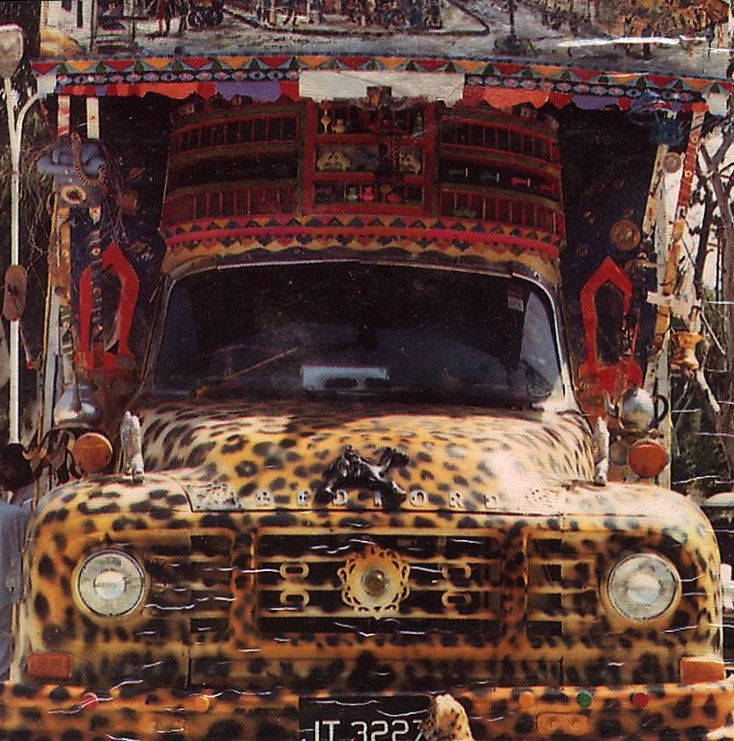
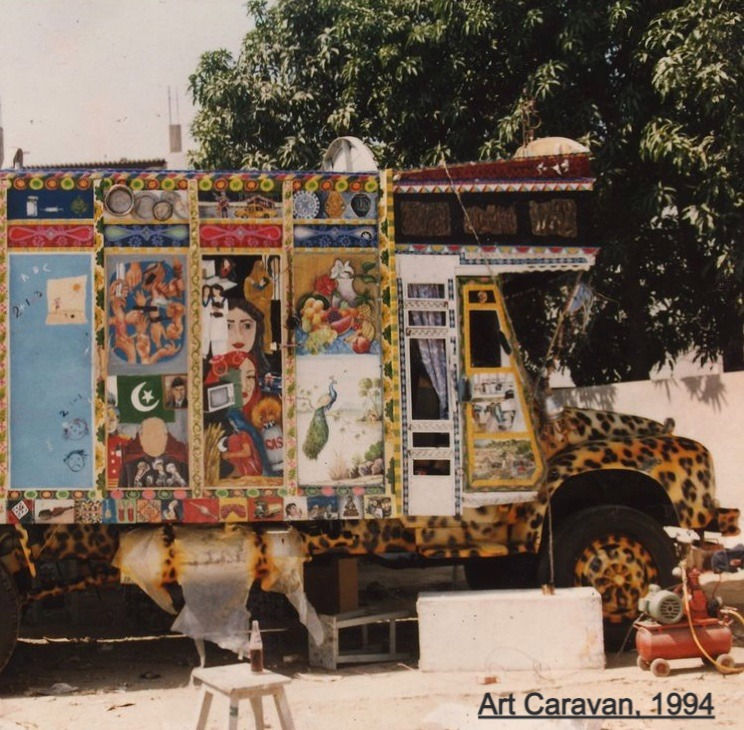
'Art caravan' was a similar truck project by David Alesworth and Durriya Kazi with the Karachi School of Art's students who collaborated in the appropriation of making 'truck' as a mobile art exhibition. It was an inspiring way to get away from the commercialized world of art and bring folk art more recognition across Pakistan by ''trans-regional dialogue''. Combining painting, sculpture and local truck art, the images of leopards, cubs, etc reflected dark hidden meanings referring to Karachi's political and social environment in the 1990s. The panels on different sides of the truck expressed the pressures faced by young individuals in difficulties of being caught in the culture of 'drugs, violence, and corruption'. It also concluded the debate of the ownership/authorship of art and gave room for self-agency. As they traveled to different cities, their work started becoming more familiar with what the newer audiences across Pakistan could relate to.[4] However, it faced the difficulty of making people understand decorative truck as art and how it differed from the normal decorative trucks they saw on the roads. This brought the debate of what constitutes art? Should art be educative? It made people compare the art made with a degree (art institution) versus self-taught art (local truck artists and cinema painters).[5] Duriya Kazi had also received an email saying, '' 'the fantasies of uneducated masses ...Image-making in itself cannot be art. For it to be art, it must have an agency. It must contain reflection and contemplation, by which it must declare itself as an art beyond its (decorative) visibility.''[6] Durriya Kazi referred to this collective exhibition as "the unwanted tapestry of our lives. Many of the images on the truck are a strong protest against this lifestyle. Primarily it is the voice of optimism, of youth, of the faith that there is no step too small to bring a better future."[7]


Pakistani society does face pressure from the western capitalist world as the after-effects of colonialism. Nowadays, we see the commodification of art where its value is reduced to a price tag without having knowledge of traditional meanings and contextual history. For example, we see 'cultural appropriation'' by designers who copy truck art imagery on shoes, bags, and clothes without having an understanding of the devices used by traditional truck artists such as black lines/borders with patterns and colors used in the same language as the ceilings of pre-partition palaces, shrines, and mosques. [8]


Very very sweet Medina, 1999, Mixed media including wood, synthetic polymer paint, glitter perspex, wheels, speakers, tube lights, fairy lights, stickers, folders, paper, Cabinet: 146 x 46 x 46cm; Painting: 183 x 183cm
Truck and cinema art constitutes a major part of collective projects and activities by these groups for artists. The project ''Very very sweet Medina'' refers to the idea: the home is where the heart is and is not confined to space. It also refers to different migrations throughout history to achieve success and happiness. David Alesworth, in the painting, had made an Australian boy in his homeland garden.[9] Later on, all the different depictions of this installation till today take the viewers in a dream-like state which helps us overcome the existing pressures of society. It was also referred to as the fantasy of living in a 'safe' place especially when Karachi was undergoing massive violence and assassinations. The artisans had also made desks for people to view the work and fill questionnaires. In the end, it was observed how people had the same wishes even though they lived in different places and conditions.
Art and entertainment, during the 1980s, had disappeared from everyday life. Moreover, the Lollywood cinema industry closed down because of heavy taxation and the requirement to have a college degree to make films. [] The Pop art movement started by this group of artists was a response/critique to making Pakistan an Islamic state when indeed its history is diverse and has people belonging from an un-Islamic region (subcontinent).[10] The images of a man and woman intimately close or a sexual pose of a female celebrity served as the means of protest against unfair laws and declared the disapproval of the city's state. The rickshaw design evolution also allowed the usage of stickers from which the drivers could easily insert figurative elements and texts. For example, when the Government of Punjab banned 'shisha', the rickshaw drivers extensively began using the stickers of a males' puffing and smoking. Furthermore, they used stickers of dancing couples in Pakistani and western attires. Texts included ‘popular’ Sufi poetry, local proverbs as well as witty statements to let the problems of politics reemerge in the society. [11]Recently, at a talk, Azis Sohail mentioned that perhaps the Karachi pop movement was indirectly a feminist movement to examine the role of women in public spaces.[12]


Karachi has always been a diverse city in terms of cultures, ethnicities, traditions, etc. Political leaders come and take ownership and control over the activities yet no one enters to improve the situation. The democratic government in the 1990s bought about hope and opportunities along with an influx of foreign capital. With the increase in globalization, communication was made better in terms of internet providence and better transportation.[13] Karachi, also being a port city, is a center of employment, where people come from different places to reside and get good jobs. Between all this, we lose the true culture of Karachi. A project, Arz-e-Mauood (The Promised Lands), by Kazi and Aleswotth in 1997 was an effort to understand people's desires, where they come from, and how they can be satisfied. Indirectly it also gathered voices and stories from people from different generations to define ‘true culture’ and initiate conversations within a space. Public spaces, such as Bagh-e-Jinnah Park, were the new 'radial mode of art production' since it meant more inclusion and participation. during this exhibition, it was revealed that ''“Rs 8 was the price of a human life”.[14] This was found written on one of the boards along with a bullet. Furthermore, the activities such as 'physical facebook', photobooth, and tailer at hand encouraged people to open up in a public space, where they were previously shunned down. [15]
These artworks, sculptural installations, and exhibitions by these four artists were a successful way to overcome their anxieties (during the 1990s regarding the city) and collaborate over similar thoughts to look at ''mass production and consumption of goods in an urban space''. [16]
Bibliography:
[1] Kazi, Durriya, '' ARTSPEAK: ART AND CENSORSHIP'' https://www.dawn.com/news/1515855 [2] ''Censoring the image'' https://www.dawn.com/news/923159/censoring-the-image [3] Murtaza, Zohreen, ‘’DISCOURSE: THE LEGACY OF POP ART'' https://www.dawn.com/news/1580563 [4] Kazi, Durriya, ‘’ Stepping over the fence’’ https://aaa.org.hk/en/ideas/ideas/stepping-over-the-fence [5] Covington, Richard, https://archive.aramcoworld.com/issue/200502/masterpieces.to.go.the.trucks.of.pakistan.htm [6] Kazi, Durriya, ‘’Stepping over the fence’’ https://aaa.org.hk/en/ideas/ideas/stepping-over-the-fence [7] CULSHAW, PETER ‘’ Exhibitions: truck art'' https://www.independent.co.uk/arts-entertainment/exhibitions-truck-art-1590143.html [8] Kazi, Durriya, ‘’ Stepping over the fence’’ https://aaa.org.hk/en/ideas/ideas/stepping-over-the-fence [9] Murtaza, Zohreen, ‘’ THE BAZAAR, ARCHIVE AND THE CURIOUS ARTIST ‘’ http://www.artnowpakistan.com/the-bazaar-archive-and-the-curious-artist/ [10] Dadi, Iftikhar, ‘’ Modernism and the Art of Muslim South Asia ‘’ https://books.google.com.pk/books?id=QbrqCQAAQBAJ&pg=PA222&dq=iftikhar+dadi+and+elizabeth+dadi+pop+art+in+karachi&hl=en&sa=X&ved=2ahUKEwj3p9jLmKrtAhUSXsAKHTt9BAYQ6AEwAHoECAYQAg#v=onepage&q=iftikhar%20dadi%20and%20elizabeth%20dadi%20pop%20art%20in%20karachi&f=false [11] Sasanka Perera, Dev Nath Pathak, ‘’ Intersections of Contemporary Art, Anthropology and Art History in South..’’ https://books.google.com.pk/books?id=zNKJDwAAQBAJ&pg=PA86&dq=pop+art++movement+in+karachi+1990s&hl=en&sa=X&ved=2ahUKEwiPxO65mKrtAhXRiVwKHdUIAnYQ6AEwAXoECAEQAg#v=onepage&q=pop%20art%20%20movement%20in%20karachi%201990s&f=false [12] ‘’Karachi Seminar: Critical Perspectives on Art and Education’’ https://habib.edu.pk/HU-news/karachi-seminar-critical-perspectives-on-art-and-education/ [13] Lindgren, Allana, and Ross, Stephen, ‘’ The Modernist World ‘’ https://books.google.com.pk/books?id=YFvLCQAAQBAJ&pg=PA151&dq=pop+art++movement+in+karachi+1990s&hl=en&sa=X&ved=2ahUKEwiPxO65mKrtAhXRiVwKHdUIAnYQ6AEwAHoECAIQAg#v=onepage&q=pop%20art%20%20movement%20in%20karachi%201990s&f=false
[14] NASAR, HAMMAD, ''Karachi Pop: Vernacular Visualities in 1990s Karachi'' https://www.guggenheim.org/blogs/map/karachi-pop-vernacular-visualities-in-1990s-karachi [15] ''Durriya Kazi and folk art in Pakistan'' https://www.domusweb.it/en/art/2004/05/06/durriya-kazi-and-folk-art-in-pakistan.html [16] Glaser, Linda B., ‘’ New exhibit finds art in unusual places ‘’ https://news.cornell.edu/stories/2018/08/new-exhibit-finds-art-unusual-places


Comments