Interview with Antony Gormley (2020)
- Amna Qamar

- Nov 10, 2020
- 4 min read
Updated: Nov 17, 2020
Antony Gormley is a British artist known for his sculptures, installations and public projects that explore the relationship of human body to nature.
AQ. Your work encompasses elements of science, physics, anthropology and Buddhist meditation. To what extent do you feel knowledge equates expertise?
AQ.


Sleeping place, 1973, plaster socked sheets

Untitled, 1988, Lead series
You have spent most of your time in London, while also travelling extensively to different countries to exhibit your work. You have met various people ( with different habits, identities etc. ) and gained inspiration from cultures. You once mentioned that in India you were interested in how the homeless people on the road made their own private spaces within a public realm. After all this global exposure, your work with human postures is non-Eurocentric and does not rely on 'western' culture, identity or historical context. The audiences are able to view the work from their own perspectives and form personal memories and realizations. In your opinion, should an artist's work reflect their or their country's identity or serve the masses?
AQ.


Field, 1989, Salvatore Ala Gallery, Milan. ‘Asian Field’ (2003)
1,200 terracotta figures overall dimensio-
ns variable, each approx. 20 cm (7 7/8 in.)
Your work aims at making us realize our relation with space and nature. 'Field' includes two different formations, one appears to be more of a gathering allowing the viewer to move around and view each piece individually, while the other completely excludes the viewer. How do you decide the placement of your art pieces within a space keeping in mind the dynamic role between the art piece and viewer?
AQ.


'Human', 2015, at Fort Belvedere, Florence
Art and politics go side by side, in 'Critical Mass' you incorporated a Renaissance Florence architectural fort ( initially built as a hideout place) and used it to display contemporary art. How do you see bi-lateral relationships between infrastructure, architecture and human beings. What's the difference in viewer perception and meaning of art when the same sculpture body is placed in a gallery space or within a socio- political ground?
AQ.
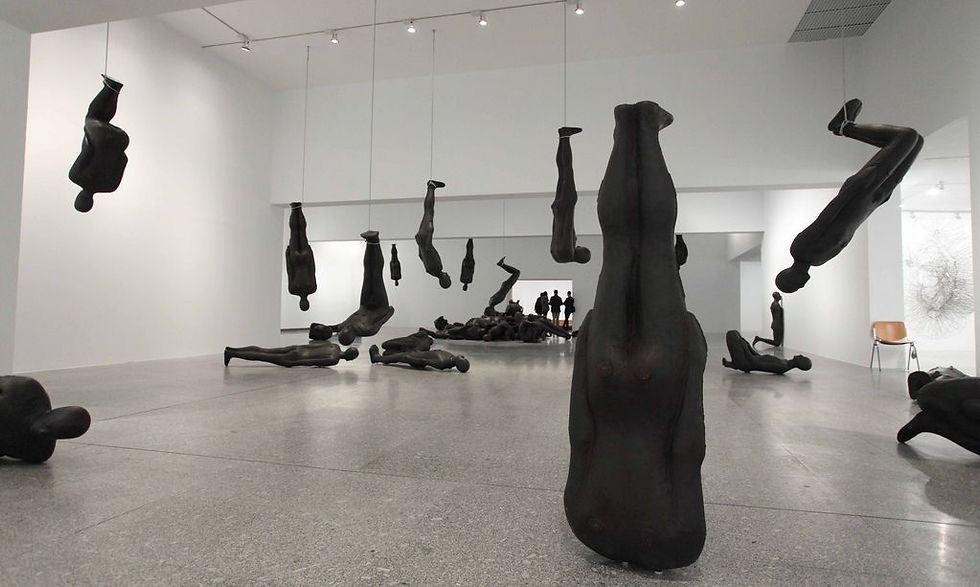
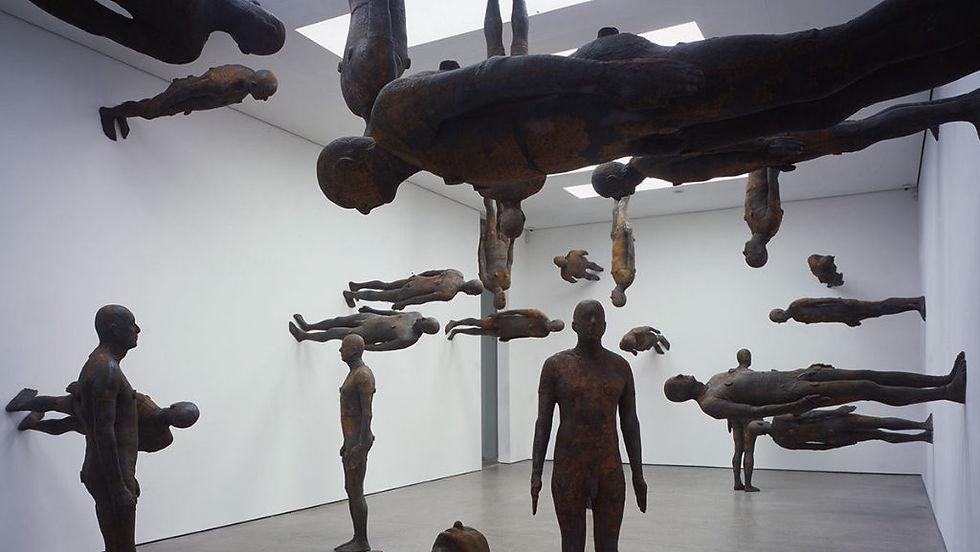
'Lost Horizon I' (2008), White Cube gallery,
Your projects comment on '' diversity and unity'' and the ''individual and the collective.'' You have primarily used your own body casted in 'Lost Horizon' sculptures. All figures are the same except differing in posture. There is a conscious attempt to reduce all sense of individuality or sexuality as all your statues are male having the same dimensions and expressions. These statues also comment on mass production of art in industries. What happens if a sculpture is repeated within a space?
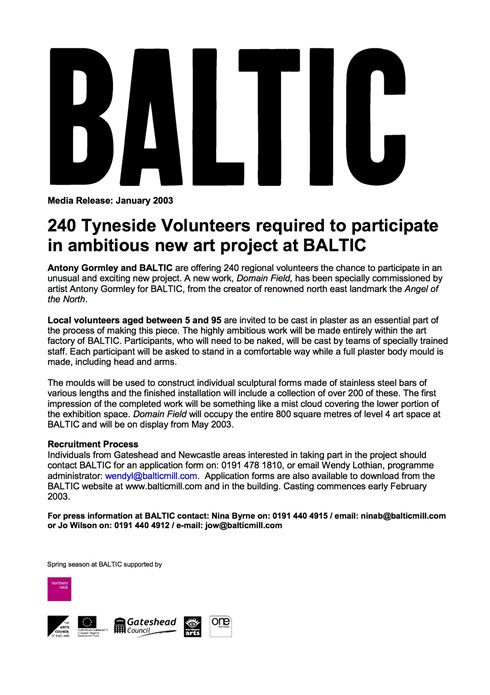

Furthermore, your work was also criticized for being 'self centric'. What was the thinking behind the making of 'Domain field' where you overcame all the critiques by inviting participants of all ages and involving them into the procedure of making molds. If you were to compare both the attempts of working with a 'single body' or 'multiple bodies', how would you say the responses different and which can be called more successful?
AQ.




When you place your work in a public sphere, you leave it for the audiences to react. Reactions can be of all sorts, how do you detach your own presence and feelings from your statues? Furthermore, some of your projects intentionally invite the viewer to participate, while in some cases the viewers are self motivated. We see people attaching gender stereotypes to the 'bodies' by using blue to signify male and pink to show a female role. It is also used as a form of entertainment. This form of intervention by the public completely changes the context of your work. Where does public art interaction end and vandalism begin?
AQ.


Evening IV Connection by Antony Gormley,
Water-dispersed aniline dye
Your drawings ''display the connection of man and earth, raising questions as to how humans are impacting the planet through climate change.'' These drawings were published in ''Guardian along with an extract of Naomi Klein's book on climate change.'' Contemporary art has leaned towards the consumerism side where it is treated as any other commodity in a market. With art fairs and biennales, the cost and usage of energy to transport art and display art has increased. Furthermore, your large scale installations are impossible to be moved except by machinery. How do you as an artist avoid the ''profligate use of resources'' and cater to evolutionary needs towards art while also keeping in mind the negative impacts onto the environment?
AQ.


You describe your work process as 'collective cohesion'. Art, at all times, requires a high level of skill and time, which raises that question of authorship of art. Art is owned by the one who does the signature or a photograph is owned by someone who clicks the shutter. We see that artists like Damien Hirst and Jeff Koons find it justifiable to leave art production to factories. You also employ many workers and technicians in work in a huge studio that caters the use of large heavy machines. Do you feel relationship between artist and hired help is temporary? How do you view fulfillment as a group project in your practice?
AQ. With technological advancements, your process of making sculptural installations has also evolved. Your assistants used to cast your mold (taking hours) but now it's easy to just take a digital scan. This deprived you from your meditative and personal time that you practiced in that given time but allowed you to experiment more. Which process do you prefer and how did it impact the final outcome? What lies ahead of this?
AQ. Clearing (2004 - 2020)


CLEARING VII, 2019, Royal Academy of Arts, London, Aluminum tube, dimension variable.


Clearing (2020), Brooklyn Bridge Park, 11-mile continuous “line” of square aluminum tubing.
In your 'Clearing' series, we observe how the installation is supported by architectural elements in galleries or other places, but the latest 'Clearing' stands vast alone in the public realm. This was a part of the 'Connect BTS' project, why did you decide to collaborate with a Korean brand? How do you think celebrity K-pop culture added to your audience?
AQ.


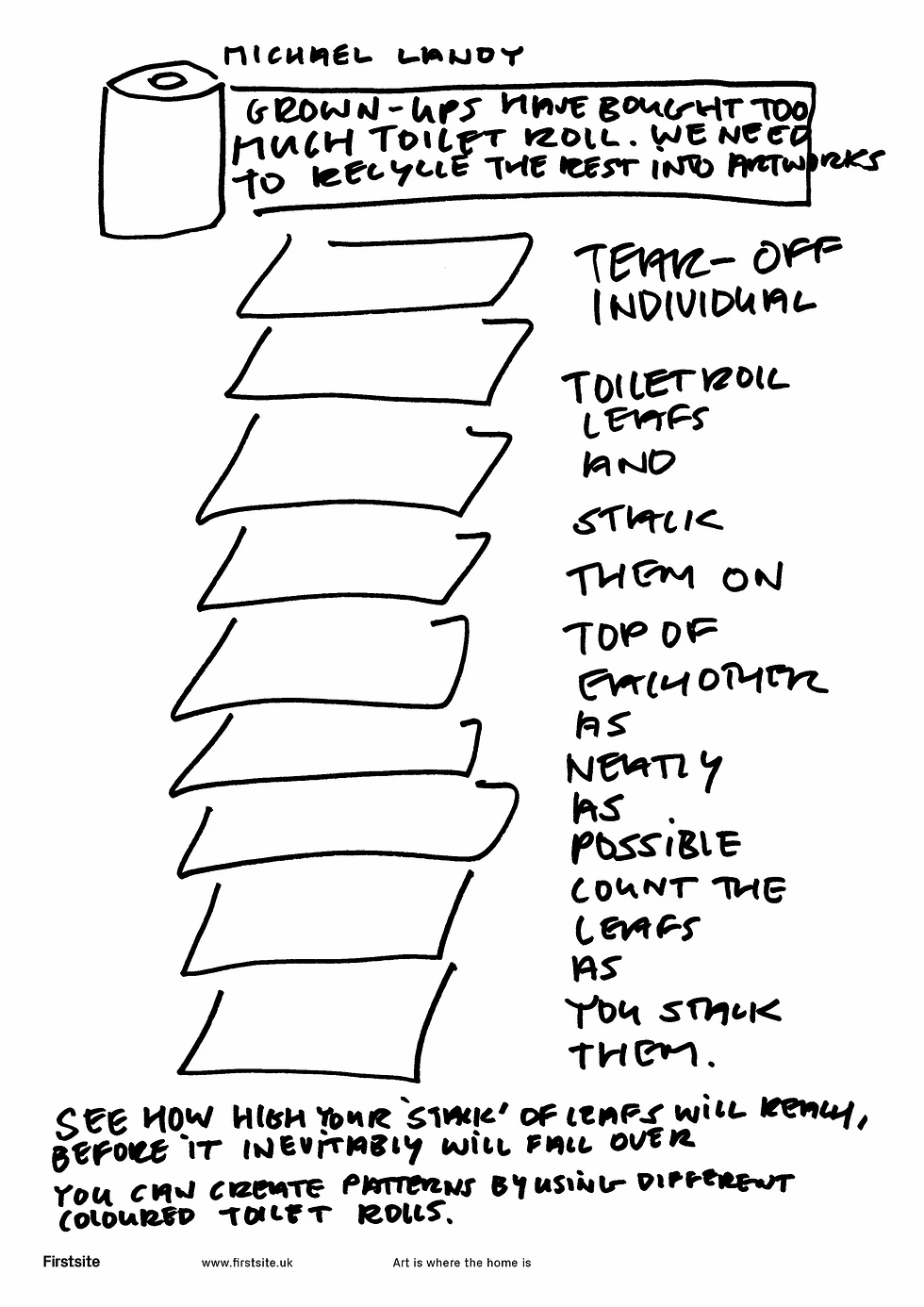


https://www.itsnicethat.com/news/firstsite-art-is-where-the-home-is-art-030420
The pandemic has led most people (adults and children) to turn to arts and craft in their free time. You have collaborated with Grayson Perry and other artists to make a package ' Art is where home is' which includes activities and online apps available for everyone. White Cube gallery also posted pictures of your daily life activities on Instagram to maintain the pre-Covid connection between artist and audience. In your experienced years as an artist, do you feel art has the ability to improve mental health especially during this time?


Comments