QADAM
- Amna Qamar

- Oct 23, 2020
- 3 min read
Updated: Oct 30, 2020

Mandate: 'Qadam' is about moving and stepping ahead. It includes all movements and progressions we make in everyday life and how they are affected by poorly maintained infrastructure in third world countries. It brings focus on issues of urbanization, disorderly planning, classism, environmental degradation and loss of human life by exhibiting sculptural installations and photography.
It is a collective of multidisciplinary artists and social workers: Amna Qamar (Karachi, Pakistan), Olafur Eliasson (Denmark), Ayesha Zulfiqar( Pakistan), Ilkka Halso (Finland) and Alamgir Khan (Karachi) and his team members. Our work revolves around bringing public and government attention to provide better infrastructure, each of us will contribute with our expertise mutually with either artistic practice or relations with the government and public sector. Our team members have travelled from abroad and gathered in Karachi to work on the upcoming projects that will displayed in galleries and public spaces.


'Rawangi' (flow, movement) is a landscape installation underway at the Canvas Gallery (Karachi, Pakistan). It will be open for viewers on 5th November, 2020. We are using found materials ,stones and mud, and arranging them with the help of our labor staff. Ayesha Zulfiqar's work revolves around the materiality of objects, how they have their own body and substance. The material used (concrete, mud etc.) allows the viewer to look at form the way it is and also make something new out of it. The installation will be an extension of Olafur Eliasson's project, 'Riverbed', combining and commenting on the deteriorated and broken infrastructure in Karachi. The viewers will be able to interact by picking the extra residue (by spade) and filling the drenches and uneven surfaces. The aim of this project would be to spread awareness about increasing urbanization and the mismatch by the government to build strongly planned roads which can withstand the heavy vehicles and changing climatic changes. Viewers will experience movement, perception and feelings. Furthermore, the landscape will consist of different anecdotes and memories that the viewers might attach to it or bring in from their past experiences. It will strive to look at society at large as to how individuals can make change or help by making the walking area better. By the end we would access peoples' reactions and see to what extent has our initial installation been modified.


Ilkka Halso records landscapes through her photography. Her focus is on restoring , protecting and understanding the anatomy of her subjects, therefore, she sees the land as as a human body which we can slice and cut it into biopsies. For her work, she uses a remote-controlled multicopter and flashlights which freely move above the landscape. By this, she successfully highlights boundless details and gets hundreds of frames from every location that can be manipulated in different ways. For another upcoming project (due in November), 'Kia dekhna chahiyay' ( what should be our focus), we will incorporate her working style and focus on development of roads to ensure safety. While photographing, we will include the keen learners to join our process. Furthermore, we'll encourage the people to send us a picture of their poor road infrastructure and provide information regarding it. For example, how long has the 'khadda' or 'manhole' been there? Has it caused any accidents? These prints will be put up on advertisement boards in different locations across Karachi and will be sent to respective authorities to ensure proper infrastructure.


Alamgir Khan started the 'Fixit' campaign to highlight the issue of non-availability of basic infrastructure and how it hinders daily lives. He added, ''I am like any other Karachi resident, but I will not sit quietly like the others.'' His existing work already creates a dialogue between politics and society. Furthermore, his team and his links with the government which be of immense benefit for our project and its aim.
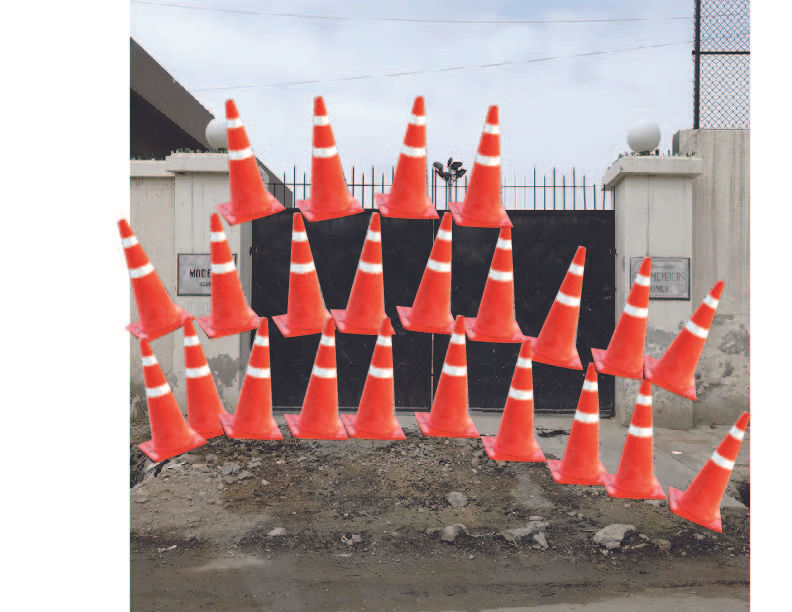

In relation with the 'Kia dekhna chahiyay' project we will highlight road infrastructure which cause accidents and uncomfortable journeys. Putting orange blocks, red flags or broken branches isn't enough. By collaboration we will use each 'khaddas' as a space for sculptural installations to bring in public attention to art and its relation to society. Above are examples of ideas and exploration process of what our installations will look like. All members together will take a tour around Karachi to mark out specific roads and areas that will be a part of this project. We plan to incorporate different locations, roads in Defence as well as roads in Nazimabad, to get a diverse data and responses. It will also assess if classism plays a role, if any, in directing and gaining enough attention by authorities to fix inadequate infrastructure facilities.
These massive and exaggerated installations will build awareness for change, address the curious minds, connect people to their surroundings and create spaces for people to actively participate in solutions.


Comments